
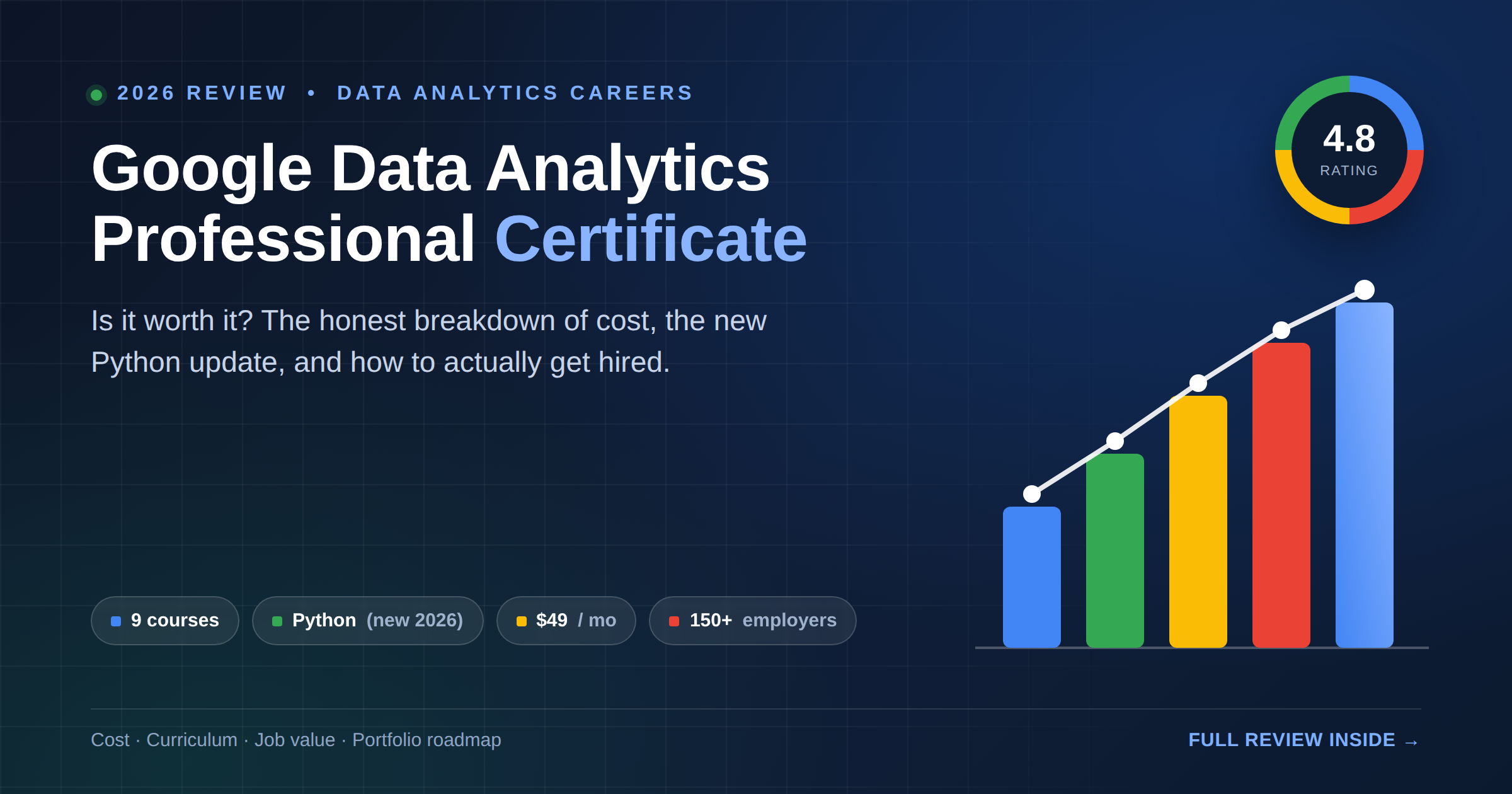
The Google Data Analytics Professional Certificate is the most popular entry point into data analytics on the internet, with more than 3.6 million learners enrolled through Coursera. It is also one of the most debated credentials online. The same two questions come up constantly: “Is it actually worth it?” and “Can you actually get hired with just this certificate?”
https://www.coursera.org/professional-certificates/google-data-analytics
This review answers both questions honestly, drawing on Google’s official data, independent salary research, peer-reviewed studies, and real learner outcomes. It also fixes the mistake in almost every competing article: most reviews still describe the old version of the certificate. Google rebuilt it. The current program on Coursera is a nine-course series that teaches Python instead of R, builds in AI-assisted analysis, and includes a dedicated job-search course. If a review still says “eight courses, R only, no Python,” it is describing a version that no longer sits on the live Coursera page.
Below is everything that matters, plus original tools you will not find in competing guides: a Key Takeaways box, a Job-Ready Stack, a certificate-to-job gap checklist, an ROI breakdown, a PROVE portfolio framework, a 90-day plan, and a decision tree for whether you should enroll at all.
Research note: All program details, prices, and statistics in this review were verified in July 2026 against the official Coursera program page, Grow with Google, and the underlying source data (Lightcast, Google’s May 2025 impact report, and the Athey–Palikot Stanford working paper). Coursera can change course content, regional pricing, enrollment options, and promotions at any time, so confirm the current details on the official program page before you pay.
Is the Google Data Analytics Certificate Worth It?
Yes. The Google Data Analytics Professional Certificate is worth it for beginners who want an affordable, structured introduction to data analytics (about $49/month, typically under $300 total). It teaches genuinely job-relevant tools (spreadsheets, SQL, Tableau, and now Python) and carries real hiring recognition through Google’s 150-plus employer consortium. But it does not get you hired on its own. Graduates who land jobs pair the certificate with a strong portfolio, deeper SQL practice, and interview preparation.
The honest one-line version: the certificate teaches you the vocabulary and the tools; your portfolio and interviews get you the job.
It is a strong fit when you:
- Have little or no analytics experience and want a clear learning sequence instead of scattered tutorials.
- Want a low-risk way to test whether you actually enjoy data work before committing to a degree or bootcamp.
- Want introductory, hands-on exposure to spreadsheets, SQL, Tableau, and Python.
- Plan to build original portfolio projects afterward.
- Can finish quickly enough to keep the monthly subscription cost down.
- Understand that the certificate supports a job search but does not guarantee employment.
It may be the wrong choice when you:
- Already use SQL, Python, spreadsheets, and Tableau confidently.
- Need advanced statistics, machine learning, Power BI, or data engineering.
- Expect Google to place you directly into a job.
- Want a formal, exam-based professional certification.
- Need guaranteed university credit.
- Only want a certificate image rather than the underlying skills.
Final verdict: It is one of the best-value first moves in a data career, but treat it as step one of three or four, not the finish line.
Key Takeaways
- It’s a foundation, not a job guarantee. For under $300 you get a structured, beginner-friendly on-ramp into analytics, but the credential alone rarely produces interviews. Your portfolio is what converts it into offers.
- The 2026 version is meaningfully upgraded. It now runs nine courses, teaches Python (NumPy, Pandas) instead of R, weaves in AI-assisted analysis, and adds a dedicated AI job-search course. Ignore reviews describing the old R-only, eight-course program.
- The tools are real and job-relevant: spreadsheets, SQL, Tableau, and Python, wrapped in Google’s Ask, Prepare, Process, Analyze, Share, Act workflow.
- Depth is the honest limitation. SQL and Python coverage is introductory; there is no Power BI, little statistics, and no machine learning. You will finish able to use these tools, not to breeze through a technical screen.
- Read Google’s stats carefully. The “75% positive career outcome” figure is a self-reported 2022 US graduate survey, and it counts raises and promotions, not just new hires. The “$97,000 median” is a field salary for data-analytics roles, not verified graduate earnings.
- Speed saves money. Because it is a $49/month subscription, finishing in 4–8 weeks can cost one month or less; drifting to eight months roughly doubles the bill. Financial aid and employer, library, or workforce sponsorships can waive it entirely.
- The winning formula: certificate + one BI tool and SQL practiced to interview depth + two or three published projects + clear communication.
Google Data Analytics Certificate at a Glance
| Feature | Current details (verified July 2026) |
|---|---|
| Provider | |
| Learning platform | Coursera |
| Curriculum | Nine-course series, including a capstone |
| Program level | Beginner (no degree or experience required) |
| Format | Fully online and self-paced |
| Programming language | Python (R was removed from the Coursera curriculum) |
| Main tools | Spreadsheets, SQL, Tableau, Python, presentation tools |
| AI content | AI-assisted data cleaning and visualization, plus an AI job-search course |
| Official time estimate | About 6 months at 10 hours per week |
| Instruction | 180-plus hours per the program overview |
| Final project | Data analytics capstone case study |
| Standard US/Canada price | $49 per month after an eligible 7-day trial |
| Typical total cost | Under $300 before applicable taxes |
| Coursera Plus | Included |
| College-credit recommendation | Up to 12 ACE-recommended US credits or 7 ECTS credits |
| Employer network | 150-plus US employers, plus consortiums in Canada, India, Singapore, and Indonesia |
| Rating / enrollment | About 4.8 / 5 on Coursera; 3.6 million-plus enrolled |
| Job guarantee | No |
What’s New in 2026 (Why Most Reviews Are Outdated)
This section settles the “is it still relevant?” debate. Google refreshed the certificate, and the current syllabus on Coursera is meaningfully different from the version most blog reviews still describe.
It now teaches Python, not R. A dedicated course, Introduction to Data Analysis Using Python, replaced the old R course. The long-standing criticism “why does it teach R when jobs want Python?” is resolved. The live Coursera program page states plainly that it teaches Python and does not cover R in the curriculum.
AI-assisted analysis is built in. The program now shows how to use AI to help with data cleaning, structuring, and visualization ideas, which reflects how analysts actually work in 2026.
A dedicated AI job-search course was added. Accelerate Your Job Search with AI covers résumés, portfolios, interviews, and applications, and Google has added this course across its Career Certificates.
The course count grew from eight to nine.
| Older version (pre-refresh) | Current version (2026) |
|---|---|
| Eight courses | Nine courses |
| R programming | Python, NumPy, and Pandas |
| Traditional capstone | Capstone plus AI-assisted analysis |
| Basic job-prep readings | Separate AI job-search course |
A note on lingering R mentions. The transition is not reflected consistently across every page. As of July 2026, some Google-owned pages (including parts of grow.google) still reference “eight courses” or an R track, and some competing reviews claim the program teaches “both R and Python.” The Coursera program page’s own “skills” metadata even carries stale R and ggplot2 tags. The authoritative source is the live course syllabus, which is Python-only and nine courses. Google has not published a precise switchover date, so treat any specific “it changed on X date” claim (including in older reviews) with caution. Before enrolling, open Course 7 and confirm it is Introduction to Data Analysis Using Python. Coursera typically gives already-enrolled learners a teach-out window to finish a retired course version, so if you started the R track, check your dashboard for your completion deadline.
The takeaway: if your only hesitation was “it’s old and R-only,” that objection no longer holds. The bigger, still-valid concern is depth, which the rest of this review covers honestly.
What Is the Google Data Analytics Professional Certificate?
It is a self-paced training program that introduces the work performed by junior and associate data analysts. It follows the real analyst workflow that Google summarizes as Ask, Prepare, Process, Analyze, Share, Act:
- Ask – understand a business problem and ask useful questions.
- Prepare – collect and organize data.
- Process – clean and validate it.
- Analyze – analyze the data to answer the question.
- Share – visualize and communicate the findings.
- Act – deliver a recommendation and complete a portfolio case study.
The curriculum was created by Google employees and includes videos, readings, quizzes, hands-on labs, and practice-based assessments. Coursera positions it as preparation for entry-level roles, not advanced analytics or data science.
What You Actually Learn: The 9 Courses
| # | Course | What it builds | Main tools | Est. hours |
|---|---|---|---|---|
| 1 | Foundations: Data, Data, Everywhere | Analyst mindset, data life cycle, ecosystem vocabulary, ethics | Concepts | 13 |
| 2 | Ask Questions to Make Data-Driven Decisions | Structured problem-solving, stakeholder questions | Spreadsheets | 15 |
| 3 | Prepare Data for Exploration | Data types, bias, ethics, databases, basic SQL | SQL, spreadsheets | 19 |
| 4 | Process Data from Dirty to Clean | Data cleaning, integrity, validation, documentation | Spreadsheets, SQL | 16 |
| 5 | Analyze Data to Answer Questions | Sorting, filtering, formulas, pivot tables, joins, aggregation | Spreadsheets, SQL | 26 |
| 6 | Share Data Through the Art of Visualization | Dashboards, data storytelling, presentation | Tableau | 19 |
| 7 | Introduction to Data Analysis Using Python | Python fundamentals, NumPy, Pandas, cleaning, analysis | Python | 27 |
| 8 | Google Data Analytics Capstone: Complete a Case Study | An end-to-end project for your portfolio | Your choice | 11 |
| 9 | Accelerate Your Job Search with AI | Résumé, portfolio, interview, and application prep | AI career tools | 6 |
A few courses deserve extra context:
Course 5 (Analyze Data) is the longest non-programming course and one of the most technically important: pivot tables, SQL queries, joins, and aggregation are daily analyst work.
Course 7 (Python) is the headline 2026 improvement. Python appears across analytics, automation, and data science. But 27 hours can only provide an introduction, so plan to keep practicing after the certificate.
Course 8 (Capstone) is explicitly meant to become your first portfolio piece. Do not submit the same bike-share or fitness-tracker analysis that thousands of other learners use; apply the process to a different dataset.
What this honestly gives you: working literacy in the core analyst toolkit and a repeatable process for approaching a business question. What it does not give you: deep, interview-grade fluency in any single tool. You will finish able to use SQL, not necessarily to breeze through a hard SQL screen. Closing that gap is the whole point of the Job-Ready Stack below.
What Skills Will You Learn?
Spreadsheets. Functions, data organization, formulas, pivot tables, sorting, filtering, and cleaning. Still relevant because many entry-level analysts work in Excel or Google Sheets even when the company also uses databases and BI tools.
SQL. Foundational SQL for selecting, filtering, cleaning strings, joining tables, running calculations, and querying relational databases. SQL is one of the certificate’s most important skills, but the course does not give most beginners enough repetition to reach interview-ready depth. Plan to practice CTEs, subqueries, window functions, date logic, conditional logic, multi-table joins, and query debugging on your own.
Tableau. Visualizations, dashboards, and data storytelling. The emphasis is on communicating what a result means and what decision it supports, not just producing attractive charts.
Python (NumPy, Pandas). You should finish able to organize, clean, and analyze data in Python at a basic level. Do not expect one introductory course to prepare you for advanced programming, automation, statistics, or machine learning.
Analytical thinking. Defining a problem, asking the right questions, evaluating data quality, spotting bias, and connecting analysis to business decisions. These habits transfer between tools even as software changes.
Data communication. Translating analysis into dashboards, presentations, data stories, recommendations, and stakeholder updates, the skill beginners most often neglect.
AI-assisted analytics. Using AI to help clean and structure data, draft formulas, generate visualization ideas, and prepare job applications. You remain responsible for verifying AI-generated formulas, code, and conclusions.
What the Certificate Does Not Cover Deeply Enough?
The program provides breadth; entry-level hiring often demands depth. Here is what the certificate introduces versus what you will still need to add.
| Covered by the certificate | You will still need to build |
|---|---|
| Spreadsheet foundations | Advanced SQL (window functions, complex joins, query optimization) |
| Basic SQL | Power BI (the program teaches Tableau only) |
| Tableau dashboards | Statistics (hypothesis testing, regression, A/B testing) |
| Python basics (NumPy, Pandas) | Advanced Python (APIs, error handling, reproducible workflows) |
| Data cleaning | Data modeling and engineering (ETL, warehouses, pipelines) |
| Data storytelling | Real workplace ambiguity (messy data, conflicting stakeholders) |
A few of these deserve a pointer to the right next step:
- Statistics and machine learning point to the Google Advanced Data Analytics Professional Certificate.
- Data modeling, ETL, and warehousing point to the Google Business Intelligence Certificate.
- Power BI points to Microsoft’s Power BI Data Analyst Professional Certificate, which also preps for the PL-300 exam.
And the gap no course fully closes: real workplace ambiguity. Course datasets are far tidier than reality. Actual projects involve missing documentation, conflicting stakeholder demands, access restrictions, shifting deadlines, and metrics that different departments calculate differently. The certificate teaches the process; experience teaches the judgment.
Is the Certificate Difficult?
It is genuinely beginner-friendly. Google requires no degree and no prior tool experience, and assumes only high-school-level math and curiosity. Most learners find Courses 1–4 easy and Courses 5–8 (SQL, Python, and the capstone) more demanding, which is exactly where the real learning happens.
The honest warning from Reddit and reviewers: the material can feel too easy, which lulls people into thinking they are job-ready when they are not. Passing a guided SQL quiz is not the same as solving an unfamiliar SQL problem under interview pressure. Treat the “easy” feeling as a signal to add outside practice, not as proof you are done.
A practical readiness test. Before claiming a skill on your résumé, check whether you can do it without copying the lesson:
- Can you import an unfamiliar dataset and identify missing or duplicated values?
- Can you write a SQL join without reviewing the course?
- Can you build a Tableau dashboard from a brand-new dataset?
- Can you clean and analyze data in Pandas from scratch?
- Can you present three useful recommendations and explain your analysis’s limitations?
Passing a quiz proves course completion. Solving a new problem proves transferable skill.
How Long Does It Take?
Coursera estimates about six months at 10 hours per week, and describes the program as 180-plus hours of instruction and assessments. Your real timeline depends on your background.
| Weekly study time | Approximate timeline (180 hours) |
|---|---|
| 5 hours | ~36 weeks |
| 8 hours | ~23 weeks |
| 10 hours | ~18 weeks |
| 15 hours | ~12 weeks |
| 20 hours | ~9 weeks |
The individual course cards above total about 152 hours, while the program overview says 180-plus; the larger figure likely accounts for assessments, review, and project work. Budgeting 150 to 200 hours is realistic for planning.
Can you finish in one month? An experienced learner can, by watching videos at higher speed through familiar topics. A true beginner would need roughly 45 hours per week, enough to earn the certificate without retaining much.
Can you finish inside the 7-day free trial? Unrealistic for most beginners, and Coursera generally withholds a certificate earned during a trial until the trial ends and the first payment processes.
How Much Does It Cost? (Plus the ROI Math Nobody Shows You)
The certificate is billed as a Coursera subscription: $49/month in the US and Canada after a 7-day free trial. There is no flat one-time price, so your total cost is set by how fast you finish.
| Completion time | Subscription cost before tax |
|---|---|
| 1 month (or inside the trial) | $0–$49 |
| 2 months | $98 |
| 3 months | $147 |
| 4 months | $196 |
| 5 months | $245 |
| 6 months (default pace) | $294 |
| 8 months (if you stall) | $392 |
Three cost facts the sign-up flow does not spotlight:
Finishing faster literally costs less. A motivated full-time learner can complete it in 4–6 weeks and pay one month, or nothing if they finish inside the trial and cancel before renewal.
Financial aid can waive the cost. Apply for Coursera Financial Aid on the course page and expect roughly a two-week wait. Avoid starting the free trial while an aid application is pending, since starting a paid subscription can supersede it. For a multi-course program, aid is granted per course, so you may need to request it for each course.
Someone may already pay for it. Many US libraries, employers, schools, and state workforce boards offer free Google Career Certificate access or scholarships.
Is it included with Coursera Plus? Yes. A direct $49/month subscription is cheaper if this is the only certificate you want and you finish quickly. Coursera Plus makes more sense if you also plan to take Google Advanced Data Analytics, Google Business Intelligence, Microsoft Power BI, or IBM Data Analyst.
Are there free alternatives? Kaggle Learn, freeCodeCamp, and Google’s own free skill materials teach overlapping SQL, Python, and spreadsheet skills at no cost. The trade-off is that free options lack the structured sequence, graded assessments, employer consortium, and recognized credential. Many learners use free resources to test their interest, then enroll for the structure and the credential.
The ROI math
Google cites a median salary of about $97,000 for data-analytics roles with 0–5 years of experience (Lightcast US job-postings data, 2025) and 270,000-plus open jobs in the field. The broader labor picture supports strong demand: the U.S. Bureau of Labor Statistics projects data and analytics occupations to grow much faster than the average for all jobs through the early 2030s. Even discounting that median heavily (realistic first offers for career changers often run $55,000–$80,000 in many US markets) a sub-$300 course against a field paying that much means the credential pays for itself quickly if it helps you land a role. The “if” depends on your portfolio, not the certificate.
Does the subscription stop automatically? Coursera says Professional Certificate subscriptions generally end once you earn the full certificate, but review your billing after completion. Canceling never removes certificates you already earned; unfinished work simply becomes available again if you resubscribe.
Is It Worth It? An Evidence-Based Verdict
Most articles ranking for this keyword are affiliate pages that conclude “yes, absolutely!” and move on. Here is the version that respects your time and money.
The stats Google reports, and how to read them honestly?
- 75% of graduates report a positive career outcome (new job, raise, or promotion) within six months of completion.
- Median salary near $97,000 for data-analytics roles (0–5 years of experience).
- 270,000-plus open roles in the US.
These figures are real, but read them with three caveats:
- The 75% is self-reported survey data (a United States 2022 graduate survey), and people who respond to such surveys skew positive. “Positive outcome” also includes raises and promotions for people who were already employed, not only new analytics hires.
- The $97,000 is a field median for the role, not verified average earnings of certificate graduates. It tells you what analyst jobs pay, not what you personally will earn straight out of the program.
- The credential is no longer rare. Google reports more than one million Career Certificate graduates globally, and over 350,000 in the US (May 2025 impact report), so the certificate itself no longer differentiates you the way it once did.
None of this makes the certificate a bad deal. It makes it a foundation with a strong price-to-value ratio, not a salary guarantee.
What independent research suggests?
A Stanford working paper by economist Susan Athey and co-author Emil Palikot, The Value of Non-Traditional Credentials in the Labor Market, studied roughly 880,000 Coursera learners and tested whether encouraging people to share completed micro-credentials affected employment. The nudge raised credential sharing by about 17 percent (a few percentage points in absolute terms); the encouraged learners were about 6 percent more likely to report new employment and about 9 percent more likely to report a job related to the certificate. The study mostly covered learners in developing countries across business and tech courses, so it is not specific to Google Data Analytics.
The lesson is not that sharing a certificate guarantees a job. It is that a credential has more value when employers can see it and it is attached to demonstrable skills.
Where it clearly is worth it?
You are a beginner who wants structure over a chaotic pile of tutorials; you want a low-risk way to test whether you enjoy data work; you want a recognizable name on your résumé and LinkedIn; or you want a guided capstone to seed your first portfolio project.
Where it falls short?
Depth (it introduces tools rather than making you fluent), saturation (over a million hold it, so it no longer differentiates you), and the “certificate equals job” trap: the most common regret online is not the money, it is expecting the paper alone to land interviews.
Verdict: Worth it as step one of three or four, not as a finish line. Internalize that going in, and it is one of the best-value credentials in tech.
Can You Get a Job With Just This Certificate?
Short answer: rarely on its own, and regularly when combined with a portfolio and practice.
What the certificate does for your job search:
- Signals initiative and baseline literacy to recruiters and applicant-tracking systems.
- Unlocks direct application to the 150-plus employers in Google’s Career Certificates Employer Consortium (members include Deloitte, Target, Verizon, and Google itself), with separate consortiums in Canada, India, Singapore, and Indonesia.
- Provides career support: coaching, mock interviews, and résumé tools.
What it does not do:
- Prove you can solve an unfamiliar business problem.
- Replace a portfolio, which is what hiring managers actually scrutinize.
- Clear a technical SQL or case interview by itself.
The employer consortium is genuinely useful but widely misunderstood: it is a channel to apply, not a guarantee to be hired. Consortium members still interview you like any other candidate. It does not mean Google reviews every résumé or reserves jobs for graduates.
The realistic path to hire: certificate, then one BI tool and SQL practiced to interview depth, then two or three portfolio projects with business context, then active networking and applications. That combination works. The certificate alone, blasted to 200 postings with no portfolio, is the pattern behind most “I heard nothing back” posts.
Original Framework: The 4-Layer Job-Ready Stack
Competitors tell you to “build a portfolio” and leave it there. Here is a concrete framework for turning the certificate into an actual hire. Each layer multiplies the one below it.
Layer 1 – Credential (the foundation). The certificate itself. Proves you completed structured training. Necessary, not sufficient. Time: the program.
Layer 2 – Tool depth (the differentiator). Pick one BI tool (Tableau or Power BI) and SQL, and practice each past beginner level: 50-plus SQL problems on a practice platform, and one dashboard rebuilt from scratch without instructions. This is the layer that survives a technical screen. Time: 3–5 focused weeks.
Layer 3 – Portfolio (the proof). Two or three projects that each answer a real business question end to end, published where a recruiter can click them (GitHub, Tableau Public, or a simple site). The capstone counts as one. Time: 2–4 weeks. See the blueprint below.
Layer 4 – Signal (the amplifier). A tight résumé naming the tools, a LinkedIn “Licenses & Certifications” entry with your credential link, a short write-up of each project, and consistent networking. This turns proof into interviews. Time: ongoing.
Rule of thumb: one certificate + three shipped projects beats five certificates and zero projects, every time. Recruiters buy demonstrated work, not completion badges.
The Portfolio Blueprint
Your capstone should be the beginning of your portfolio, not the end of it. Two tools make each project recruiter-ready: the PROVE framework (structure) and three concrete project templates (substance).
The PROVE framework for every project
- P – Problem. State the business question in one sentence. Weak: “I analyzed a sales dataset.” Strong: “The company wants to understand why repeat purchases declined in the second half of the year.”
- R – Reliable data. Document the source, variables, missing values, duplicates, possible bias, limitations, and cleaning decisions.
- O – Original analysis. Show work beyond a copied tutorial: SQL queries, a Python notebook, segmentation, trend analysis.
- V – Visual explanation. Use charts that directly answer the question, not a dashboard stuffed with unrelated graphics.
- E – Effect. Close with the main finding, a recommended action, the expected business value, risks, and the next analytical step.
Three projects that get interviews
Project 1: SQL business analysis (technical depth). Use an e-commerce, subscription, restaurant, or transportation dataset. Demonstrate joins, aggregations, date analysis, conditional calculations, CTEs, and window functions. Deliverable: documented queries plus a short findings summary.
Project 2: Python cleaning and exploration (rigor). Take a deliberately messy dataset and show importing, type conversion, missing-value treatment, duplicate removal, outlier investigation, grouped analysis, and reproducible code. Deliverable: a published notebook.
Project 3: Tableau or Power BI dashboard (communication). Build a dashboard for a defined audience: executive sales, customer retention, operations performance, or public-health trends. Deliverable: an interactive dashboard plus a one-page recommendation (“focus retention on month-to-month customers with high support tickets”).
The template that makes any project recruiter-ready
- Business question in one sentence.
- Data source and cleaning steps, documented honestly.
- Analysis with the actual queries or code visible.
- One clear visualization or dashboard.
- A recommendation, stated as if to a manager.
- A short “what I’d do next” to show you know the limits.
The Certificate-to-Job Gap Checklist
Before you apply for data analyst roles, confirm you can do more than complete guided exercises. If you can check most of these, you are genuinely ready.
Spreadsheets
- Use lookup functions and conditional formulas
- Clean inconsistent data
- Build pivot tables and useful charts
- Explain your calculations
SQL
- Filter, aggregate, and join multiple tables
- Use subqueries and common table expressions
- Apply window functions and work with dates
- Debug incorrect results
Python
- Import and inspect data with Pandas and NumPy
- Clean missing and duplicated values
- Group, summarize, and visualize data
- Explain your code
Visualization
- Select an appropriate chart and build a dashboard
- Avoid misleading scales; use accessible labels
- Connect visuals to recommendations
Business analysis
- Turn a vague request into a measurable question
- Identify useful metrics, assumptions, and limitations
- Communicate with non-technical stakeholders
Job search
- Publish three original projects
- Tailor your résumé and prepare five project stories
- Practice SQL interview questions and apply to adjacent analyst titles
Jobs You Can Target
Coursera designs the certificate for roles including junior and associate data analyst, operations analyst, finance analyst, business-intelligence analyst, healthcare analyst, and HR or payroll analyst. Titles and required skills vary widely, so also search for reporting analyst, marketing analyst, sales analyst, workforce analyst, product-operations analyst, data-quality analyst, customer-insights analyst, supply-chain analyst, and revenue-operations analyst.
Your prior industry is your edge. A retail worker can analyze sales and inventory; a teacher can analyze education data; a healthcare administrator can examine patient-flow data; a marketer can analyze campaigns; a finance employee can build reporting and forecasting projects. Domain knowledge is what separates you from other certificate graduates competing for the same entry-level roles.
Should You Enroll? A Quick Decision Tree
Use this to decide in under a minute.
1. Do you already write intermediate SQL and Python and build dashboards confidently?
- Yes: Skip the foundational certificate. Go straight to Google Advanced Data Analytics or a Python-forward program.
- No: Continue.
2. Do you need advanced statistics, machine learning, data engineering, or a formal exam-based certification?
- Yes: Choose a specialized program (Google Advanced Data Analytics, Google Business Intelligence, or Power BI/PL-300) instead of, or after, this one.
- No: Continue.
3. Are you willing to build original portfolio projects and practice SQL after finishing?
- No: Reconsider. The certificate alone rarely produces interviews.
- Yes: Enroll. You are the ideal candidate. Set a fast schedule to control cost, and start the 90-day plan.
The 90-Day Plan That Produces a Portfolio, Not Just a Certificate
Aim for roughly 15–20 hours per week. This compresses the certificate and layers on the practice that actually gets you hired.
Weeks 1–3 – Courses 1–4 (foundations). Do every hands-on activity, not just the quizzes. Recreate exercises without instructions and save useful formulas and queries.
Weeks 4–7 – Courses 5–7 (SQL, visualization, Python). In parallel, start a free SQL practice platform and do a few problems daily. Batch the video-heavy parts; slow down for SQL and Python.
Weeks 8–9 – Course 8 capstone. Treat it as a real portfolio piece using the PROVE framework and a non-default dataset, not a checkbox.
Weeks 10–11 – deepen and build. Complete 30–50 original SQL problems (joins, CTEs, window functions, dates, case statements). Build one Python notebook and one Tableau or Power BI dashboard from raw data.
Week 12 – Course 9 plus launch. Publish everything (GitHub, Tableau Public, or a simple site), update LinkedIn and your résumé, prepare five project stories and an application tracker, and start applying. Begin applying before you feel perfectly prepared.
Prefer a slower pace? Stretch this across 16 weeks at 10–12 hours per week; the sequence is identical, just less compressed. The one rule: do not let a three-month program drift to eight months. Every extra month is another $49 and fading momentum.
Common Mistakes Learners Regret (From Reddit and Reviews)
- Treating the certificate as the finish line. It is step one. The people who “got nothing back” almost always skipped the portfolio.
- Never practicing SQL outside the course. Guided exercises do not prepare you for a technical screen.
- Collecting more certificates instead of building projects. A second or third project helps; a second or third certificate rarely does.
- Publishing nothing. If a recruiter cannot click your work in ten seconds, it does not exist to them.
- Ignoring communication. Analysts are hired to explain findings to non-analysts. Every project should end in a plain-English recommendation.
- Dragging it out. Lost momentum is the top reason people never finish self-paced programs.
Google Data Analytics vs the Alternatives
| Program | Best for | Level | Main tools | Notable difference |
|---|---|---|---|---|
| Google Data Analytics | Absolute beginners | Entry | Spreadsheets, SQL, Tableau, Python | Broadest on-ramp; the default first step |
| Google Advanced Data Analytics | Grads of the first cert | Advanced | Python, statistics, regression, ML | 7 courses; deeper, Python-and-stats heavy; do this after |
| Google Business Intelligence | Aspiring BI analysts | Advanced | SQL, Tableau, ETL, data warehousing | 4 courses; data modeling and reporting infrastructure |
| IBM Data Analyst | Beginners wanting Python earlier | Entry | Python, SQL, Excel, Cognos, Jupyter | ~11 courses; awards an IBM digital badge |
| Microsoft Power BI Data Analyst | Power BI-focused roles | Entry–Intermediate | Power BI, DAX | 8 courses; preps for the PL-300 certification exam |
How to choose:
- New to analytics? Start with Google Data Analytics.
- Already have the basics or a technical background? Skip to Google Advanced Data Analytics or a Python-forward option.
- Want dashboards and reporting systems? Add Google Business Intelligence.
- Job postings in your area ask for Power BI more than Tableau? Add Microsoft’s Power BI certificate.
Many strong candidates do Google Data Analytics first, then Advanced Data Analytics, and treat the pair as a beginner-to-intermediate pipeline. Whichever you pick, none of them eliminates the need for independent projects.
Google vs IBM in detail: IBM’s program has more courses (around 11 vs 9), leans more tool-heavy with Excel, Jupyter, and Cognos, awards an IBM digital badge, and typically takes about four months. Choose Google for a clear analysis framework, stakeholder communication, Tableau, and Google branding; choose IBM for more Python exposure, Jupyter notebooks, and several portfolio projects.
Accreditation, College Credit, and the “Certificate vs Certification” Question
Is it accredited? It is not a bachelor’s degree, diploma, or professional license. However, the American Council on Education (ACE) recommends it for up to 12 US college credits (or 7 ECTS in Europe). A recommendation is not guaranteed credit: each institution decides whether to accept it, how many credits it awards, and whether it counts toward your major or as an elective. Because the curriculum moved from R to Python, ask your school whether its policy applies to the exact version you completed, and get written confirmation before enrolling solely for academic credit.
Is it a certificate or a certification? It is a Professional Certificate, earned by completing Coursera courses and passing assessments, not an independent, exam-based certification like Microsoft Power BI Data Analyst Associate (PL-300), CompTIA Data+, Certified Analytics Professional (CAP), or Tableau Certified Data Analyst, which require a separate standardized exam.
On your résumé, write “Google Data Analytics Professional Certificate.” Do not write “Google-Certified Data Analyst,” which wrongly implies Google formally certified your professional competence through a licensing exam.
Does it expire? Earned certificates stay in your Coursera account after you cancel, and the verification link keeps working. The document does not expire, but your skills can go stale; keep practicing current Python libraries, SQL, a BI tool, and AI-assisted workflows. A certificate earned years ago is far more persuasive next to recent projects.
How to Put It on Your Résumé and LinkedIn?
Résumé: use the exact credential name and connect it to evidence.
Basic:
Google Data Analytics Professional Certificate | Google / Coursera Completed: July 2026 · Skills: SQL, Python, spreadsheets, Tableau, data cleaning and visualization · Credential: [verification link]
Stronger (project-focused):
Google Data Analytics Professional Certificate | Google / Coursera Completed 180+ hours of training in SQL, Python, spreadsheets, Tableau, and data storytelling. Built an independent customer-retention analysis using 80,000 records and presented three recommendations through an interactive dashboard.
Place it under Certifications, Professional Development, or Technical Education, never as a university degree.
LinkedIn: add it through the Certifications section, including the credential name, Google as provider, the completion date, the credential link, relevant skills, and your portfolio link. Do not publish only the certificate image; add a short explanation of what you built. The Stanford research suggests making a micro-credential visible improves its signaling value, especially if you have few other professional signals.
Pros and Cons
Advantages: beginner-friendly with no prerequisites; fully online and self-paced; relatively affordable; structured learning path; current Python instruction; foundational SQL and spreadsheets; Tableau training; data-cleaning practice; strong business and stakeholder focus; a portfolio capstone; AI-assisted analytics content; a dedicated job-search course; ACE and ECTS credit recommendations; and a recognized Google-branded credential.
Disadvantages: the certificate alone rarely creates job readiness; SQL and Python coverage is introductory; no Power BI; limited statistics and no machine learning; no deep data engineering; capstone topics get repetitive across learners; monthly cost grows when progress is slow; the employer consortium is not job placement; some official pages still show outdated R information; and the widely cited outcome figure is a self-reported survey.
What Real Learners Say
Online discussions reveal a consistent pattern. The threads below are representative of the recurring debates on Reddit (paraphrased summaries; usernames retained where quoted).
Success comes from the portfolio, not the paper. In a widely read r/dataanalysis success-story update, a career changer who moved from hospitality into a roughly $85k analyst role credited the certificate but stressed that it only worked alongside real projects and people skills. As one commenter put it: “The certificate itself means nothing. You need to take open source datasets and tell a visual story with them so you can show them to potential employers.” (r/dataanalysis, 2024)
Hands-on experience outweighs the credential. In an r/analytics thread on becoming an analyst without a degree, the consensus was that the certificate helps but is secondary to demonstrable work: “The Google course can help but your hands on experience using data in your current role will matter a lot more.” (r/analytics, 2024)
“Easy and surface-level” is the most common critique. In an r/datascience discussion, learners warned that nearly everyone transitioning already holds the certificate and that it barely scratches the basics: “Both are pretty easy and surface level, neither will help one get a job.” (r/datascience, 2023)
The depth reputation persists into 2025. A recent r/analytics poster echoed the familiar worry before enrolling: “any reviews about Google Data Analytics on coursera? I heard its all theory and no practical practices?” (r/analytics, 2025)
These are anecdotes, but their consistency underlines the theme running through this entire review: the gap between guided coursework and independent analysis is real, and the graduates who close it with projects are the ones who get hired.
The Google Data Analytics Professional Certificate remains one of the better entry points into analytics in 2026. Its strengths are structure, accessibility, affordability, and breadth, and the updated Python curriculum aligns it more closely with the wider analytics and data-science ecosystem. Its main weakness is the gap between course completion and professional competence; no single program makes you fully proficient in spreadsheets, SQL, Tableau, Python, business analysis, and stakeholder communication.
The takeaways in one glance:
- It is a strong, affordable foundation (under $300, beginner-friendly), not a job guarantee.
- The 2026 version is upgraded: nine courses now teach Python, AI-assisted analysis, and job search; ignore reviews describing the old R-only, eight-course program.
- Your portfolio is the deciding factor. The certificate opens the door; two or three real projects walk you through it.
- Read the stats honestly. The 75% outcome figure is a self-reported 2022 US survey, and the $97,000 salary is a field median, not a promise.
- Finish fast to save money and momentum, and publish everything you build.
The strongest strategy in one line: certificate + one BI tool and SQL practiced to interview depth + three published projects + clear communication. Do that, and this becomes one of the best-value first moves in a data career. Treat the certificate as the whole plan, and it will disappoint.
Frequently Asked Questions
Is the Google Data Analytics Professional Certificate worth it in 2026? Yes, for beginners who want an affordable, structured foundation. It teaches real tools, is recognized by employers, and costs under $300. It is not worth treating as a job guarantee; graduates who get hired pair it with a portfolio and extra SQL practice.
Did the certificate replace R with Python? Yes. The current version teaches Python through Introduction to Data Analysis Using Python and no longer covers R in the Coursera curriculum. Some older and regional pages (and outdated reviews claiming it teaches “both”) still describe the previous R-based version.
How many courses is it, and is there a capstone? Nine courses, including a capstone case study designed to become your first portfolio project. The older version had eight.
How long does it take? Coursera estimates about six months at 10 hours per week. A realistic total is 150–200 hours; full-time learners often finish in 4–8 weeks.
How much does it cost? $49/month on Coursera after a 7-day free trial, so usually under $300 total depending on your pace. Financial aid and employer, school, or library sponsorship can reduce or eliminate the cost.
Is it free? Auditing shows limited materials but gives no certificate. For a genuinely free certificate, apply for Coursera Financial Aid or check whether your employer, school, library, or a workforce program sponsors access.
Is it included with Coursera Plus? Yes, Coursera currently lists it as included.
Can I finish it in one month, or during the 7-day trial? An experienced learner can finish in a month; most beginners cannot meaningfully complete 180-plus hours that fast. Finishing the whole program within seven days is unrealistic, and Coursera generally requires the first payment before releasing a certificate earned during a trial.
Is it hard? Do I need experience, a degree, or advanced math? It is beginner-friendly with no prerequisites; only high-school-level math is assumed. SQL, Python, and the independent capstone are the most challenging parts. Advanced roles later may require statistics and probability.
Do I need a powerful computer? No. A modern laptop, a stable internet connection, and a browser are enough. A laptop or desktop is far more practical than a phone for SQL, Python, and dashboard work.
Can you get a data analyst job with just this certificate? Rarely on its own. It gets you noticed and unlocks the 150-plus employer consortium, but a portfolio, tool depth, and interview skills are what convert applications into offers.
Does Google hire certificate graduates? Graduates may apply to Google and participating consortium companies, but completing the program does not guarantee an interview or a Google job.
What salary can I expect? Google cites a US median near $97,000 for data-analytics roles with 0–5 years of experience (Lightcast 2025 data). That is the field median, not verified graduate earnings; realistic first offers for career changers are often lower and vary by location, portfolio, and prior experience.
Is the certificate recognized by employers? Yes, it is a well-known Google credential backed by a 150-plus employer consortium. Recognition means it is understood and valued as a signal, not that it guarantees an interview.
Does it count for college credit? It carries an ACE recommendation of up to 12 US credits (or 7 ECTS). Each institution decides whether to accept them, so confirm with your school first.
Is it a professional certification? No. It is a course-based Professional Certificate, not an independent, exam-based certification or license.
Is it better than a degree? It is faster and cheaper but not equivalent. A degree offers deeper theory, broader education, academic credit, and access to internships and campus recruiting.
Do I keep the certificate if I cancel Coursera? Yes. Certificates you have already earned remain yours and the verification link keeps working; canceling only stops future billing and access to unfinished content.
Should I learn Power BI or take Google Advanced Data Analytics next? Learn Power BI if local job postings request it more than Tableau. Take Google Advanced Data Analytics when you want statistics, regression, machine learning, and deeper Python.
Google Data Analytics vs Google Advanced Data Analytics: which first? Start with Google Data Analytics if you are new; take the Advanced certificate afterward (or instead, if you already have the basics).
Is the capstone enough for a portfolio? It can be your first project, but build at least two more original projects; recruiters see many portfolios based on the same Google case-study datasets.
References and Sources
All figures in this review were verified in July 2026 against primary sources. Citations are grouped by type so you can weigh the authority of each claim yourself.
Official program and provider data
| # | Source | Publisher | What it verifies |
|---|---|---|---|
| 1 | Google Data Analytics Professional Certificate | Coursera (official program page) | Course count, Python curriculum, price, rating, enrollment |
| 2 | Grow with Google – Data Analytics Certificate | Salary median, open-role count, employer consortium | |
| 3 | Google Career Certificates Impact Report, May 2025 | Google (The Keyword) | 1M+ global and 350,000+ US graduate figures |
Independent research and labor-market data
| # | Source | Publisher | What it verifies |
|---|---|---|---|
| 4 | Athey, S. and Palikot, E. – The Value of Non-Traditional Credentials in the Labor Market (Stanford GSB · arXiv 2405.00247) | Stanford Graduate School of Business | Credential-sharing and employment effects |
| 5 | Data Scientists, Occupational Outlook Handbook | U.S. Bureau of Labor Statistics (.gov) | Projected demand for data and analytics roles |
| 6 | ACE Learning Evaluations | American Council on Education | College-credit recommendation (up to 12 credits) |
Comparable certificate programs
| # | Source | Publisher | What it verifies |
|---|---|---|---|
| 7 | Google Advanced Data Analytics Certificate | Google / Coursera | 7-course advanced track (statistics, ML) |
| 8 | Google Business Intelligence Certificate | Google / Coursera | 4-course BI track (ETL, warehousing) |
| 9 | IBM Data Analyst Professional Certificate | IBM / Coursera | ~11-course comparison, digital badge |
| 10 | Microsoft Power BI Data Analyst Associate (PL-300) | Microsoft | Exam-based Power BI certification |

 Google